
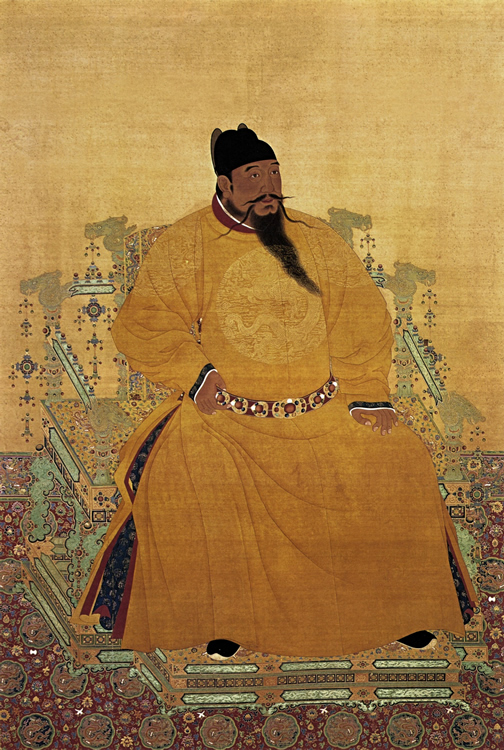
In the early 15th century, as Europe still struggled to emerge from the shadows of the Middle Ages, China stood as the most advanced and powerful civilization on Earth. The Ming Dynasty, under the ambitious rule of the Yongle Emperor, embarked on a series of naval expeditions that were unprecedented in their scale, complexity, and ambition. These voyages, commanded by Admiral Zheng He, were not merely explorations but grand demonstrations of China’s imperial might, meticulously orchestrated to project power, secure diplomatic ties, and expand commercial networks across the known world.
At the heart of these ventures was Zheng He’s formidable fleet, a marvel of engineering that showcased the zenith of Chinese naval architecture. The fleet’s crown jewels were the treasure ships, or baochuan—colossal vessels, some over 120 meters long and 50 meters wide, that dwarfed anything else afloat. These ships, built with cutting-edge technologies such as watertight compartments and reinforced hulls, were as resilient as they were massive, capable of withstanding the harshest conditions the seas could muster. Their decks, as wide as city streets, carried not only China’s wealth in the form of silk, porcelain, and gold but also the empire’s hopes of forging a new world order under the celestial mandate of the Ming.
Supporting these mighty vessels were a host of specialized ships, each integral to the success of the voyages. There were horse ships, which transported the powerful steeds that symbolized Chinese military might; supply ships, laden with provisions to sustain the fleet on its long journeys; troop ships, carrying thousands of soldiers ready to assert China’s will; and warships, bristling with cannons and other advanced weaponry, ensuring that the fleet was more than capable of defending itself or enforcing the emperor’s commands when necessary.
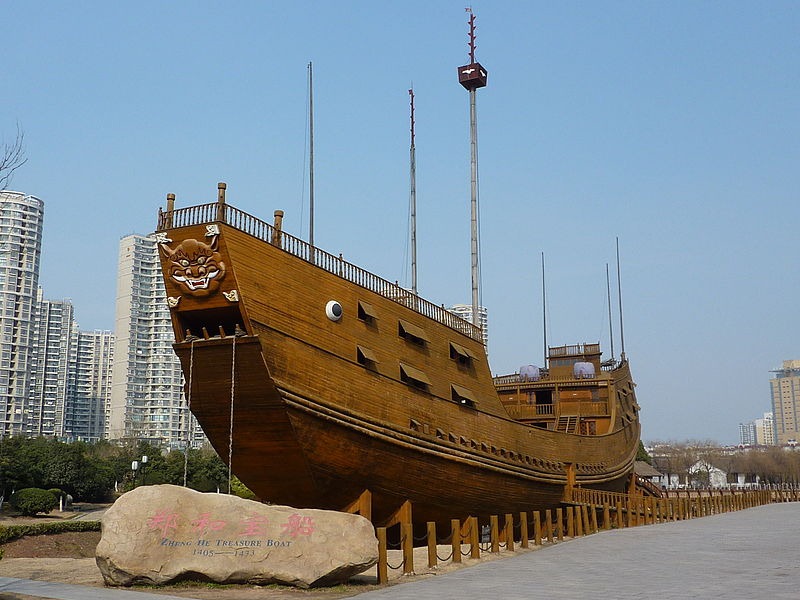
These voyages were, above all, diplomatic missions on a scale never before seen. The Yongle Emperor sought to extend his influence across the vast expanse of the Indian Ocean, and Zheng He’s fleet was his instrument. Wherever they made landfall, the Chinese envoys presented lavish gifts to local rulers, establishing tributary relationships that brought far-flung regions into the orbit of the Middle Kingdom. These gestures of goodwill were not mere formalities; they were strategic maneuvers designed to weave a network of alliances that would secure China’s place at the center of a global system.
But the fleet’s mission was not solely diplomatic. The Ming Dynasty was keenly aware of the importance of military power in maintaining its dominance. Throughout the voyages, Zheng He’s forces engaged in military actions when necessary, from crushing pirate fleets that threatened Chinese maritime interests to intervening in regional conflicts to support allies or install friendly regimes. These actions were a clear message to the world: China’s reach was long, and its power, formidable.
Commerce, too, was a cornerstone of these voyages. The fleets carried not just diplomatic gifts but trade goods that were exchanged in the markets of Southeast Asia, South Asia, the Arabian Peninsula, and the African coast. Chinese silk, porcelain, and other luxuries were traded for spices, gems, exotic animals, and other treasures from foreign lands. These exchanges not only enriched the Ming economy but also laid the foundations for a vast, interconnected trade network that spanned continents, bringing diverse cultures into contact and fostering an unprecedented exchange of ideas and goods.
The technological prowess that underpinned these voyages was as impressive as the ships themselves. Chinese shipbuilders had refined the art of constructing large, seaworthy vessels, incorporating innovations such as watertight compartments and advanced rudder systems that made their ships both stable and maneuverable. Navigational tools, particularly the magnetic compass, were essential to the success of these long-distance voyages. Chinese mariners, guided by these compasses and detailed maritime charts, navigated the vast, often uncharted waters of the Indian Ocean with a level of precision that astonished the world.
As the fleet sailed to distant shores, it visited a wide range of ports and kingdoms, from the bustling trading centers of Southeast Asia to the spice-rich coasts of India and Ceylon, and from the affluent ports of the Arabian Peninsula to the distant, mysterious lands of East Africa. These voyages were more than just journeys of exploration; they were acts of statecraft, extending China’s influence and securing its interests across a vast and diverse world. The cultural exchanges that accompanied these voyages left a lasting impact on the regions they touched, spreading Chinese ideas and traditions while also bringing foreign knowledge and innovations back to China.
However, the remarkable era of these grand expeditions was not to last. With the death of the Yongle Emperor in 1424, the priorities of the Ming court shifted. The vast resources required to maintain such a massive naval presence were increasingly seen as a drain on the empire’s finances, especially as the threat from northern nomadic tribes grew more pressing. The decision was made to curtail these maritime ventures, and by the mid-1430s, the great treasure fleets had been disbanded. The shipyards that had once buzzed with activity fell silent, and much of the technological knowledge that had propelled Zheng He’s fleet across the world began to fade into obscurity.
Yet, one cannot help but wonder: what might have happened if the Ming Dynasty had continued its naval expeditions? Had the Chinese continued to build and expand their navy, the history of the world might have taken a very different course. With their advanced shipbuilding techniques and navigational expertise, the Chinese could have established a dominant presence across the Indian Ocean, the Arabian Sea, and perhaps even beyond. They might have extended their influence to the eastern shores of Africa, deepening their ties with the powerful trading states that flourished there, or even established colonies along the coastlines of Asia, Africa, and possibly further afield.
A sustained Chinese presence in the Indian Ocean could have altered the balance of power, challenging the rising influence of European powers like Portugal and Spain, which would soon begin their own age of exploration. The Chinese, with their vast resources and advanced technologies, might have preempted the European voyages of discovery, establishing trade networks and political alliances that could have kept the Western powers at bay. The Ming Dynasty could have become the first truly global maritime empire, with a reach extending from the Pacific to the Atlantic.
Moreover, had China continued its grand maritime explorations, the potential for increased cultural and technological exchanges could have dramatically altered the course of world history. Imagine a scenario where, instead of remaining isolated within their respective regions, the world’s major civilizations were brought into closer and more sustained contact, not just through sporadic encounters but through a steady flow of ideas, goods, and people facilitated by Chinese maritime dominance. The implications of such an interconnected global culture, emerging centuries earlier than it did in our historical timeline, are profound and far-reaching.
Chinese innovations, already pivotal in the development of global technology, could have been disseminated across the world at an accelerated pace. The compass, which was crucial in navigation and already widely used by the Chinese, could have become a common tool in global seafaring much earlier, enabling other civilizations to explore and trade more effectively. The spread of gunpowder, another Chinese invention, might have revolutionized warfare and power dynamics around the world sooner, leading to earlier shifts in the balance of power among emerging states and empires.
The printing technology developed during the Tang and Song Dynasties, which was one of the most significant advancements in the dissemination of knowledge, could have found its way to the Islamic world, Africa, and Europe much earlier through Chinese expeditions. The earlier adoption of printing technology could have led to a faster spread of literacy, ideas, and scientific knowledge across the globe. Imagine a world where the Renaissance, the Reformation, and the Scientific Revolution were sparked decades or even centuries earlier by the rapid exchange of printed texts, facilitated by a Chinese-led global trade network.
This earlier globalization, underpinned by Chinese leadership, could have also influenced the development of global trade routes. Instead of the later dominance of the Silk Road and European maritime routes, we might have seen a Chinese-led network of trade hubs stretching from the Pacific across the Indian Ocean, through the Red Sea, and into the Mediterranean. Such a network would have integrated the economies of Asia, Africa, and Europe much earlier, fostering an era of unprecedented wealth and exchange. The rise of major port cities under Chinese influence might have accelerated the urbanization and economic development of regions that would otherwise have remained on the periphery of global trade.
Diplomatically, China’s sustained presence in the Indian Ocean and beyond could have led to the establishment of alliances and tributary relationships that spanned continents. These relationships might have preempted European colonization, with China playing a central role in mediating conflicts and fostering cooperation between distant lands. The diplomatic norms and practices of the Ming Dynasty, which emphasized tribute and mutual respect, could have influenced the development of international relations, creating a world where the principles of Chinese statecraft held sway over emerging global politics.
Culturally, the world could have witnessed a richer and more diverse exchange of traditions, languages, and religious practices. The spread of Buddhism, Confucianism, and Chinese art and philosophy could have had a profound influence on the intellectual and spiritual life of other civilizations. At the same time, China itself might have absorbed and integrated elements from other cultures at an accelerated rate, leading to a more cosmopolitan Chinese society that was open to new ideas and innovations from around the world.
Such a Chinese-led globalization might have led to a more balanced and multi-polar world, where no single civilization dominated but rather a network of interconnected cultures flourished together. This alternative history could have seen the blending of Eastern and Western philosophies, leading to the development of new schools of thought that combined the best of both worlds. The arts, sciences, and technologies of this globalized world might have advanced in ways that are difficult to imagine today, with the early cross-pollination of ideas sparking innovations that could have transformed everything from medicine to mathematics to architecture.
In this scenario, the 15th and 16th centuries would have been marked by a world where China was not just a distant empire, known primarily through the accounts of the few who ventured to its shores, but a central player in global affairs, actively shaping the future of humanity. The Ming Dynasty, rather than retreating into isolation, would have led the world into an era of unprecedented connectivity and cooperation, laying the foundations for a truly global civilization centuries before the modern era.
The consequences of such a world are profound. The political, economic, and cultural landscape of today would be vastly different, shaped by centuries of Chinese influence on global affairs. The technologies and ideas that underpin modern society might have developed along entirely different lines, leading to a world where the East and West were not seen as separate or opposing forces but as parts of a single, interconnected whole. The very concept of nation-states, borders, and identity might have evolved differently, with a globalized Chinese influence fostering a more integrated and cooperative world.
Ultimately, the decision to end China’s maritime explorations and turn inward was a turning point that left this potential future unexplored. Yet, by imagining what might have been, we gain a deeper understanding of the significance of those few decades when China stood on the brink of global leadership, and of the enduring impact that even a brief period of exploration and exchange can have on the course of history.
In the end, the decision to turn inward and abandon these grand naval expeditions marked a turning point in world history. China, which had once been poised to become the dominant global power, gradually receded from the international stage, leaving the seas open for the rise of European empires. The legacy of Zheng He’s voyages remains a testament to what might have been—a brief moment when the Middle Kingdom stood on the cusp of global dominance, only to retreat back into itself, leaving the world to wonder what other wonders might have been discovered had they continued their course across the oceans.
